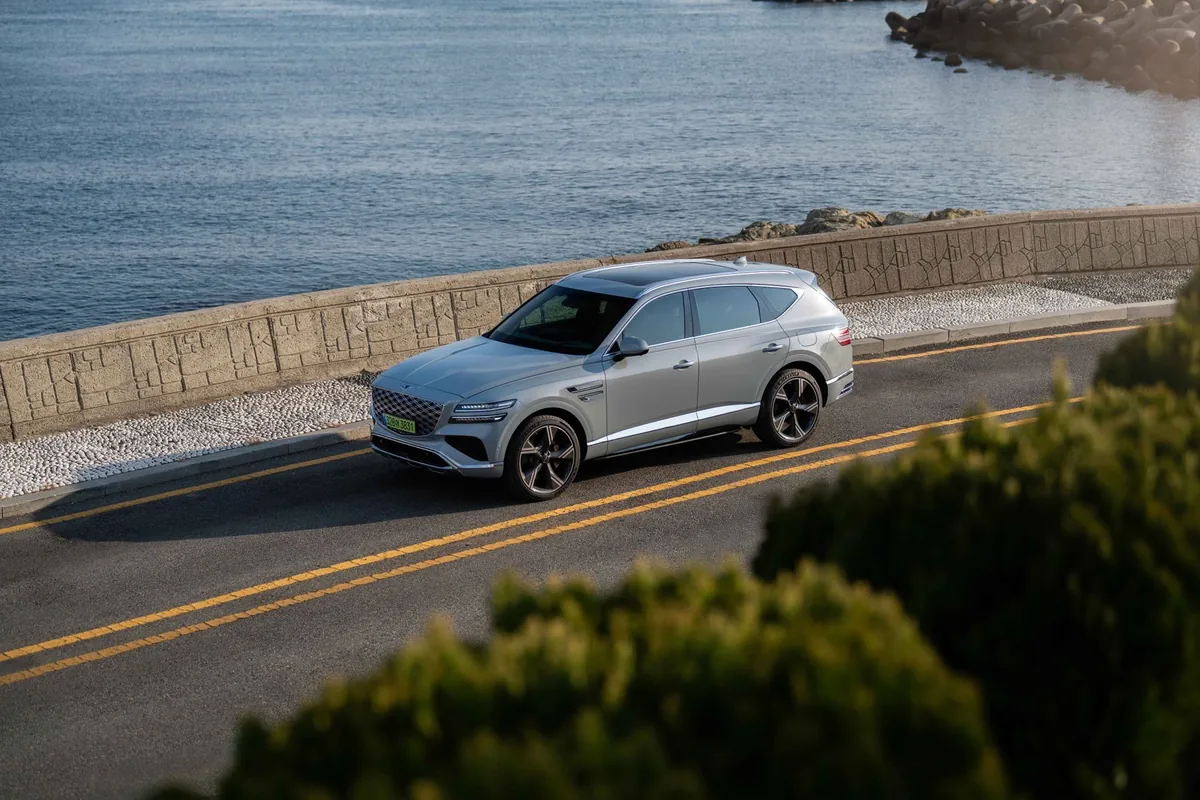
A headline promising 912 km on one tank makes long-distance driving sound much easier. That figure comes from the GV80 Hybrid Genesis introduced on October 6. But what configuration and conditions sit behind it? Anyone considering the car should start by unpacking that number.
Genesis lists a starting price of 76.8 million won with a 5% individual consumption tax rate. Output is 352 PS and combined fuel economy is 12.0 km/L. The economy figure, however, applies to a five-seat, rear-wheel-drive model on 19-inch wheels. A number in a headline may not carry over unchanged to the car in your own quotation. The figures below were checked against manufacturer announcements and specifications on October 12, 2026.
The 912 km figure is not a road-test result
Genesis arrived at 912 km by multiplying the 76-liter fuel-tank capacity by the official 12.0 km/L combined rating. It is not a record obtained by driving until the tank ran dry. Speed, traffic, weather, and load all affect consumption, and drivers normally refuel before using every last liter. Treating 912 km as a guaranteed touring range would therefore be misleading.
Wheel and drivetrain choices matter as well. The 12.0 km/L rating is attached to a five-seat, rear-wheel-drive car with 19-inch wheels. Choose all-wheel drive or different wheels and you need to check the certified figure for that exact configuration. It is more useful to remember the rating of the car you would actually order than to memorize ‘912 km’ for every GV80 Hybrid.
Putting the number into everyday terms helps. For someone who drives about 1,000 km a month, 912 km can look like almost a month of travel. It still does not mean every tank will cover that distance. The figure is a multiplication of a certified rating and tank capacity; when you actually stop for fuel depends on your route, habits, and the reserve you leave in the tank.
The starting-price gap is 6.95 million won
The 2027 gasoline GV80 2.5 Turbo launched on the same day starts at 69.85 million won, leaving a 6.95 million won difference from the hybrid. Genesis quotes 304 PS for the gasoline model and 352 PS for the hybrid. The official specification page lists 9.3 km/L for a rear-wheel-drive gasoline 2.5 Turbo on 19-inch wheels.
69.85 million won versus 76.8 million won: the starting points are 6.95 million won apart, but that does not mean the equipment and options in the two quotations are identical.
Calling the entire gap the ‘price of the hybrid system’ would be inaccurate. The comparison does not align every standard feature and option. To estimate the real purchase difference, build both cars with the same drivetrain, wheels, seating, and desired equipment. The Genesis configurator lets you assemble the hybrid specification you would actually consider.
Fuel-economy figures also need matching conditions. The gasoline model's 9.3 km/L and the hybrid's 12.0 km/L both refer to rear-wheel-drive models on 19-inch wheels, while the hybrid figure additionally specifies five seats. If you plan to change the wheels, drivetrain, or seating layout, check whether the number you are comparing still applies.
Annual distance determines how much the difference is worth. Using only the combined ratings, 15,000 km a year would require about 1,613 liters in the gasoline model and 1,250 liters in the hybrid, a difference of roughly 363 liters. Multiplying that by the fuel price you actually pay gives a rough annual saving. Real consumption will vary, and a total-cost calculation must also account for insurance, tax, maintenance, and depreciation.
At 8,000 km a year, the same calculation gives about 860 liters for the gasoline model and 667 liters for the hybrid, a difference of about 194 liters. Better fuel economy is real, but its effect on your budget depends on how far you drive. Before applying a fuel price, check your own mileage over the past year.
Start with the driving situations that matter to you
The new model combines a 2.5-liter turbo engine, two motors, and a new seven-speed transmission. Genesis says the wider use of motor assistance improves quietness when setting off and driving in town. If you value that character as much as fewer fuel stops, compare it with the gasoline model on the same route. Output and acceleration figures alone cannot tell you which one feels better.
According to Genesis, the P1 motor handles starting and generation, while the P2 motor provides drive assistance and regenerative braking. That makes low-speed pull-away and deceleration useful moments to compare with the gasoline GV80. A press release can explain what the motors do, but only a test drive can show how the transitions feel.

On a test drive, I would repeat starts and re-acceleration on the same stretch of road. Engine noise in the cabin, brake feel during deceleration, and low-speed response are difficult to replace with a specification sheet. Drivers who spend more time on motorways should not judge the car from urban quietness alone. The difference becomes meaningful when the route resembles the roads you normally use.
The car also adds a Stay Mode for climate and media use while parked, plus vehicle-to-load power for external devices. V2L output reaches 3.6 kW, but with the engine off it becomes unavailable once the battery state of charge falls through a specified range. If this feature influences your decision, check when the engine starts and how much power your devices draw. A hybrid is not an unlimited power source in the way the feature name might suggest.
For V2L in particular, operating conditions matter more than the headline 3.6 kW figure. Anyone planning to use power while parked should ask how long it can run with the engine off and which appliances will be connected at the same time. The battery limits Genesis describes belong in that conversation. For camping or outdoor work, frame the question around your actual equipment rather than the feature name.
If I were reviewing a quotation, I would look past 912 km and first check the drivetrain, wheels, and final price I had selected. High annual mileage and frequent urban driving can make the hybrid's lower fuel use and quieter starts attractive. With low mileage, the 6.95 million won starting-price gap is harder to explain through fuel savings alone. The sensible choice is to price both versions on equal terms, drive them on comparable roads, and decide which better matches your routine.
Sources reviewed
The article was checked against the sources below. Image context and credits appear in each caption.